Alexander Technique for Musicians
Table of Content
Introduction
Every performing artist spends a l lot of time practicing, rehearsing, traveling. From the day we start our music education we start building habits in our mind and body. Some of those habits might result in pain and tension that can be dangerous to our health and career.
My guest in this episode is Liz Talbert, a flautist and Alexander Technique teacher.
Alexander Technique is a method of bringing conscious awareness to how we do things. It is often used to help musicians with specific problems, such as tension or pain when playing an instrument.
In this episode we will discuss how Alexander Technique for musicians can help lead healthier and better careers.
The key takeaways from this conversation
- Developed by an actor Frederick Matthias Alexander, AT is a method for bringing conscious awareness to how we do the things that we do.
- Alexander Technique for musicians can be used to deal with tension, performance anxiety, pain and can help change harmful habits.
- Some of the main Alexander Technique principles include becoming mindful of the way we go about our daily activities and the unity of mind and body, each constantly influencing the other.
- AT is a way to address physical discomfort and habits. The physical habits become part of our believe system (when I pick up my musical instrument or start singing, I'm also tensing up). When you break that physical habit, you also have to change the underlying belief.
- Practicing AT is not only about music, it's about everything that you do in your daily life.
You can find out more about Alexander Technique for Musicians on Liz's website, get free guided training by subscribing to her mailing list or book a private session in person in Berlin or online. Liz is also on instagram: @liztalbert


Transcript
Liz Talbert, from playing the flute to teaching AT
Iurii: Hello Liz. Thanks for joining us on this podcast. Tell me a little bit about yourself and how the Alexander Technique can help musicians live healthier and better lives.
Liz: My name is Liz. I originally trained as a flutist. I teach, I play chamber music. When I was in the music conservatory, I learned about the Alexander Technique.
At that time, I didn't seriously look into it. It just seemed interesting. It was something I kept coming back to, and after I graduated, like many musicians, I asked myself, okay, now what?
And my answer to that was, "well, you know, I've always been interested in the Alexander Technique. I'm just going to sign up for teacher training. Even if I decide not to teach, I'm going to learn something about myself and it's going to be a skill that I can use". That's what I did, and I really enjoyed it.
Now I'm teaching Alexander Technique.
What is Alexander Technique
Iurii: Tell me a little bit about what the Alexander Technique is?
I should warn you that every Alexander Technique teacher has their own definition. So my definition is that Alexander Technique is a method for bringing conscious awareness to how we do the things that we do.
Iurii: So it's not just about music? Anybody can do Alexander Technique? Is it focused more on physical exercises or mental training?
Liz: FM Alexander, who developed the technique, was an actor. A fundamental principle of the Alexander Technique is the unity of body and mind. This basically means that everything we do involves both our body and our mind. They're inextricably linked.
A very classic example of this is when you have an emotion, a really strong emotion, how do you know you're feeling that emotion? Often it's also a physical sensation, and so things like slow breathing or yoga or slowing down, going for a walk, anything that makes the body feel in a different way, affects the emotions.
When you breathe slower, you feel more relaxed. It might start with the body. Maybe you feel stressed, you have performance anxiety and someone says something really encouraging to you - it starts with the mind, but it'll affect the body. So what we teach in the Alexander Technique is body awareness.
Iurii: If we take meditation techniques or yoga, for example, is it very similar?
Liz: In my experience, yoga, for example, has its own philosophy and system of movements and techniques. I think what all of these modalities have in common is that they expand your awareness of yourself, and that increases your ability to be aware of what you're doing, and basically your ability to say, “This is what I want to do”.
The first step to that is to be realistic about yourself and be aware of what you're already doing. There are different philosophies and different ways of approaching that basic concept. Someone who's a yoga teacher or a meditation expert might disagree with me on this.
Alexander Technique as a way to deal with pain and tension
Iurii: People usually come to the Alexander lessons when they have a problem that they need to solve, right? A musician might have pain, tension, performance anxiety, they start looking for solutions and come across Alexander Technique workshop.
Did you come to Alexander Technique because of your own struggles with pain and tension?
Liz: That's exactly right. Most people think of the Alexander Technique as a way to address physical discomfort and habits. This was my experience, I had shoulder tension and it was the classic case. I knew what I needed to do differently and how it feels when I play differently.
I would think about it, but as soon as I start practicing, I get hyper-focused. Three hours go by and my shoulder hurts but I didn’t notice it while playing.
Again, it's about expanding your awareness of what you're doing and learning what you could do differently, and also learning how to change a habit.
It's a matter of attention. When your attention shifts, you go back to your old way of doing things.
How to change the habits
Iurii: Exactly. When we play musical instrument, we repeat the same movement over and over again. The physical sensations we have when we play imprint themselves on our bodies and our physical structure. It's so hard to change that, because even if we are aware of it for five minutes when we are practicing, it takes just one hard passage to steal all our focus. So how can we address that? How can we change our habits?
Liz: The key aspect of this is that these physical habits become part of what it means for us to play our instrument. It becomes part of our belief system that when I pick up my flute and play, I'm also tensing my shoulder. When you break that physical habit, you also have to change the underlying belief.
If you ask a musician, "Do you have to tense your jaw?” They will most likely say no.
If you were to then ask them, "Well, if you completely relax and let go of all that tension and then take your bow hand, does it feel like you're playing?" they might also say no. So that's part of it that I think is often not understood.
There are a couple of ways that the Alexander Technique can help with that. One of them is prevention. There's a principle of the Alexander Technique called “the means-whereby” for that.
That's basically thinking about how you're going to get to your goal. . And when I say "how," I mean "quality."
My world completely changed when an Alexander Technique teacher told me, "Hey Liz. The pain you have when you play the flute isn't just about how you play the flute. It's about how you do everything in your daily life. When you're in school, you're writing and you're bent over your desk and you're clutching your pencil, that all contributes to it. If you're carrying stuff that's too heavy; if you're feeling really stressed and clenching your jaw – all of that carries into the practice session, and all of that becomes part of the way you move when holding your instrument”.
I think part of it's starting on the right foot, and you can do that at any time. A big part of it, I think, is really consciously thinking about how you want to move and how you want to feel.
That can even be a feeling like, "Oh, I want to feel calm and confident”
That's good. How does that feel in your body? What changes when you pick up your instrument? Do you still feel that calm confidence or does something change? For me, a really important aspect, and I think this is hard for a lot of musicians, is that I think about how I'm going to play, rather than what I'm going to play and how it's going to sound in the end.
I really think about the quality of my intention when I start the process. Of course, some of the quality that you put in from the beginning is lost, but if you start with that, you have a base that you can always come back to.
How to get back to calmness after stressful passage
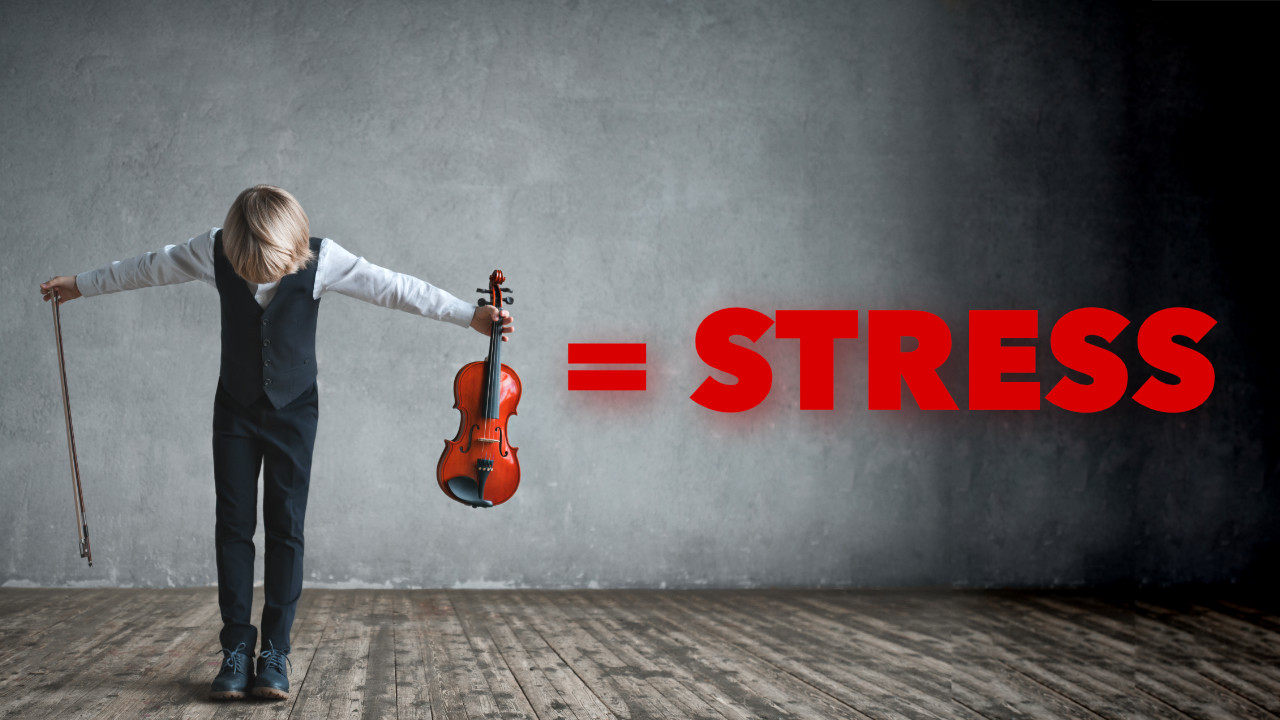
Iurii: It is stressful to work in performing arts, no matter if you are singing jazz, playing the piano, string teacher or other. Often, once you get a little stressed, you fall into a different mindset and forget to think about all the right things. How do you get back to that calmness?
Liz: There are a few ways to practice that. One is what they call in the Alexander Technique world, inhibition. Basically, that's what allows us to respond.
For example, if you see that this passage is really stressful you can respond to that instead of reacting and automatically tensing up. The key is to pause, think about the quality that I want to have, and then move on.
When you practice and know that there's a place that always stresses you out, isolate a few bars beforehand where it feels easier and just play those bars without really moving forward. Be confident, play it easy with the quality you want. Then maybe just add a note or two at a time from the difficult part. You can see where I'm going with this. You add them with the same quality and you know,” okay, I'm not going forward. I'm not doing the whole thing. It's just these one or two notes. It's really simple”...
Iurii: That's really good. I'm going to try that.
Liz: Most important thing about it is that it prepares you. You can write a cue-word, not at the difficult part, but about four measures before, when it still feels safe and easy for you. At that point you'll write a word for yourself, something that triggers in you the feeling that you want to have. And you'll say, "Oh yeah, I have that." You may lose some of that in the transition, but it's a chance for you to reconnect with yourself when it's still easy.
Iurii: Usually that happens on the contrary, those four bars before something really difficult comes, you start tensing up and dreading that moment.
Liz: But realistically, you know, those four bars before it gets hard, it's still easy.

Alexander Technique is a lifestyle, not a quick fix
Iurii: That's a very good point.
I used to meditate seriously. I went to silent meditation retreats for 10 days where you sit on the cushion for 10 days and just meditate.
It was very, very great. I really enjoyed that experience. When I came back to music making, while I was meditating, I felt good, I was making progress. The moment I stopped meditating every day, that was all gone.
Something like Alexander Technique… it's not like going to somebody and saying, "Okay, fix my shoulder". It's a lifestyle that you have to adopt, right?
Liz: Exactly, and I'd say that can be really daunting.
I remember when my Alexander Technique teacher told me that AT is about everything that you do, I was like, “oh, sh*t”.
I think that's true for a lot of musicians. They say, “it's all about how I play”. But no, it's about everything you bring to the table. And that can be really discouraging.
The flip side of that is that in a split second I can say: “Okay, what if you relax a little bit?”
At that moment, you notice a change. Maybe it's subtle, but something changes, that one thing. You can do that at any time. So if you're playing with other people and you have a break, take a deep breath, listen to your colleagues, expand your sense of self, be in the moment. That's great. Then you pick up your instrument and you've relaxed again.
That's a great opportunity.
If you notice when you're practicing, “I'm starting to tense up”, just pause right there. Take a deep breath, notice your whole self, and then keep playing. You can do that.

How many lessons do you need to start feeling the results
Iurii: How many private lessons does it take before the student will see any results? And what is the process of teaching something like Alexander Technique?
Liz: There are different pedagogical styles of the Alexander Technique. My style is more Socratic, I like to have a dialogue.
There are also styles that are very hands-on, where the teacher explains very little. They won't talk to you much. It's usually taught in person, with the teacher putting their hands on you. That was my first experience when I was playing and my teacher gently put his hand on my shoulder where it would tense up and I kept playing. That can be very powerful because you feel it.
For me, that was a really powerful first experience, but I didn't know how to do that on my own. And with the way I teach, I tend to talk to people. So I'll ask somebody “let's uncover some of these unconscious beliefs. Let's talk about how you get there yourself”.
It may be a more subtle experience than having someone really instruct you, but it leaves you with skills that you can apply yourself at any time. Then you know exactly what you're doing.
I'd say it just takes one Alexander Technique lesson to get a sense that things can be different.
I always try to give people one or two strategies to try for themselves when it comes to being in your body. I'd say it depends on the person, but I've noticed the biggest change in my students between six and ten lessons.
Iurii: How long did it take for you to feel that the tension you had was gone?
Liz: Well, I can tell you that I still have those habits when I play the flute. The difference is that I'm much more aware of it and I've a lot of tools to deal with it.
I notice it much more quickly, for example, and that's the really big difference for me.
Before, when I was practicing, I didn't notice that something was hurting until I was done. And now, as soon as I pick up my flute, I've a really clear idea of how to do what I want to do with this experience.
As soon as I start, something starts to change. I notice it immediately. So I wouldn't say that my habits are gone forever. But I'm able to deal with it in a way that I don't hurt myself anymore.
Recommendations on building new habits
Iurii: What would be your recommendation for people who want to form new habits and build a healthier relationship with themselves, with their instruments?
Liz: I've two big suggestions. One is that a lot of musicians work so hard and we feel like we don't have time to rest and that tension builds up. You're just always on the go and you don't realize that over time that becomes the new normal.
So my first recommendation would be an Alexander practice called “Constructive Rest”. I've a free recording of it if anyone wants it. Basically, it's an exercise where you lie down on the floor, put your feet on the floor so your knees are bent, and for 20 minutes you just consciously breathe and release tension from your body.
It's an opportunity to get in touch with yourself, to be present with yourself and notice how much tension you actually have. Use a guided recording or just set a timer for 20 minutes and lay on the floor and think “I'm going to let go”. When you come back to your day, you can say “I didn't need everything that I was holding onto before. I don't need that much effort”. So that's something I'd recommend to any musician.
My second point is that when you think it can be overwhelming to say, okay, I'm suddenly going to do everything differently, or I'm suddenly going to play my instrument in a different way.
So what I'd recommend is choosing a warm-up piece that you really like, something super easy. For me it’s long tones, for you it might be something else. You say “this is the time I'm going to devote to noticing my body and noticing my breath”. You can also notice the change in the sound and the relationship between your body and the breath, emotions and the sound that you're making.
You can start by spending five minutes in your practice session paying attention to yourself and how you approach the instrument. And then, sure, you will get distracted, it's hard to think about it for the whole practice session, but for five minutes you can do it, and then it'll slowly start to affect the rest of your playing.
Iurii: I'd also say that if you're going to try it, you should definitely try it with a teacher first. It's amazing that there are musicians who teach it. It’s so easy for one musician to understand the difficulties and problems that the other musician is going through.
What is the end goal of the Alexander Technique?
Liz: My goal as a teacher is to give my students more control over how they move in the world. Especially with musicians, like you said, we build these habits, even when you know it's not what you want to do, or you know you're getting in your own way, you feel kind of powerless against it.
And so my goal is to give you the tools to have control over how you want to do the things that you want to do.
Photos by Ana Torres